The History of Basketball
James Naismith was a Canadian physical educator who invented basketball in Springfield, Massachusetts, in 1891 to keep his students active during the winter. The game was an immediate success and the sport spread.
The first basketball game used baskets as hoops and turned into a brawl. Soon after, the game evolved into a pillar of American sports. During the first basketball game played in 1891, players dunked balls and scored points in a basket normally used to collect peaches.
A winter storm had forced students at the International YMCA Training School, now known as Springfield College, in Springfield, Massachusetts, to stay indoors. The usual winter gym class activities (marching, calisthenics, apparatus work) weren’t nearly as thrilling as football or lacrosse, played during the warmer seasons.
To keep his students engaged, James Naismith, a 31-year-old graduate student teaching physical education at the school, wanted to create a game that would be simple to understand but complex enough to be interesting.
It had to be an indoor game that could accommodate several players at once. It also needed to provide plenty of exercise, yet without the physicality of football, soccer, or rugby since such sports would threaten more severe injuries if played in a confined space.
Naismith approached the school janitor, hoping he could find two square boxes to use for goals. When the janitor came back from his search, he had two peach baskets instead. Naismith nailed the peach baskets to the lower rail of the gymnasium balcony, one on each side.
The height of that lower balcony rail happened to be 10 feet. The students would play on teams to try to get the ball into their team’s basket. A person was stationed at each end of the balcony to retrieve the ball from the basket and put it back into play.
Naismith had invented basketball, and the first game ever played between students was a complete brawl.
“One boy was knocked out. Several of them had black eyes and one had a dislocated shoulder.” Naismith said. “After that first match, I was afraid they’d kill each other, but they kept nagging me to let them play again so I made up some more rules.”
Basketball was invented from humble beginnings, but the only professional sport to originate in the United States laid the foundation for today’s multibillion-dollar business.
The current National Collegiate Athletic Association (NCAA) March Madness college basketball tournament includes the best 68 of more than 1,000 college teams, stadiums that seat tens of thousands of spectators, and lucrative television contracts.
13 original rules of basketball
Naismith didn’t create all of the rules at once, but continued to modify them into what are now known as the original 13 rules. Some are still part of the modern game today. Naismith’s original rules of the game sold at auction in 2010 for $4.3 million.
In the original rules, the ball (at first a soccer ball) could be thrown in any direction with one or both hands, never a fist. A player could not run with the ball but had to throw it from the spot where it was caught. Players were not allowed to push, trip or strike their opponents.
The first infringement was considered a foul. A second foul would disqualify a player until the next goal was made. But if there was evidence that a player intended to injure an opponent, the player would be disqualified for the whole game.
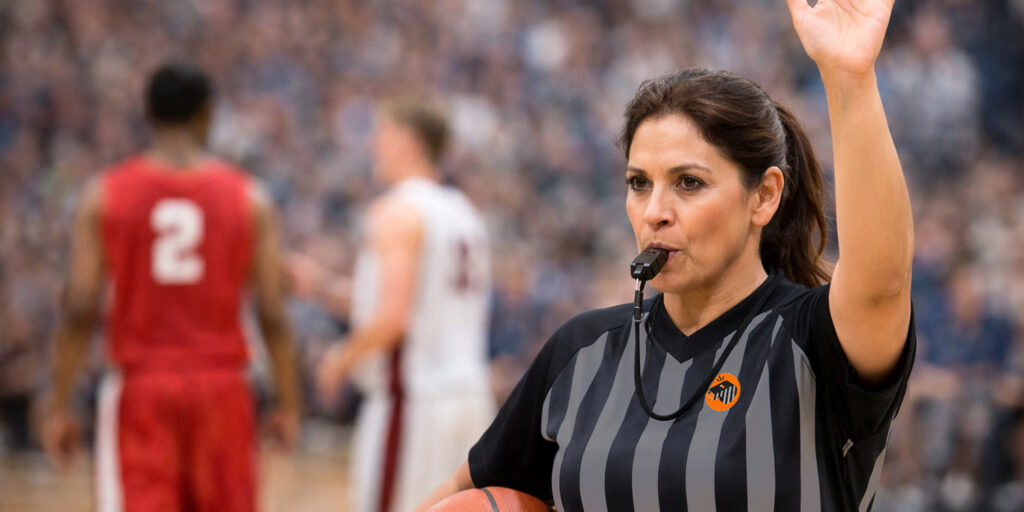
Umpires served as judges for the game. They made note of fouls and had the power to disqualify players. They decided when the ball was in bounds, to which side it belonged, and managed the time. Umpires decided when a goal had been made and kept track of the goals.
If a team made three consecutive fouls, the opposing team would be allowed a goal.
A goal was made when the ball was thrown or batted from the grounds into the basket and stayed there. If the ball rested on the edges, and the opponent moved the basket, it would count as a goal.
When the ball went out of bounds, it was thrown into the field of play by the person first touching it. The person throwing the ball was allowed five seconds. If he held it longer, the ball would go to the opponent.
In case of a dispute, an umpire would throw the ball straight into the field. If any side persisted in delaying the game, the umpire would call a foul on that side.
The length of a game was two 15-minute halves, with five minutes rest between. The team making the most goals within the allotted time was declared the winner. If a game was tied, it could be continued until another goal was made.
First public basketball games
The first public game of basketball was played in a YMCA gymnasium and was recorded by the Springfield Republican on March 12, 1892. The instructors played against the students. Around 200 spectators attended to discover this new sport they had never heard of or seen before. In the story published by the Republican, the teachers were credited with “agility” but the student’s “science”is what led them to defeat the teachers 5-1.
Within weeks the sport’s popularity grew rapidly. Students attending other schools introduced the game at their own YMCAs. The original rules were printed in a college magazine, which was mailed to YMCAs across the country.
With the colleges well-represented international student body, the sport also was introduced to many foreign nations. High schools began to introduce the new game, and by 1905, basketball was officially recognized as a permanent winter sport.
The first intercollegiate basketball game between two schools is disputed, according to the NCAA. In 1893, two school newspaper articles were published chronicling separate recordings of collegiate basketball games facing an opposing college team.
In 1892, less than a year after Naismith created the sport, Smith College gymnastics instructor Senda Berenson, introduced the game to women’s athletics. The first recorded intercollegiate game between women took place Between Stanford University and the University of California at Berkeley in 1896.